Fan-favorite guard set to make return to Razorbacks for junior season
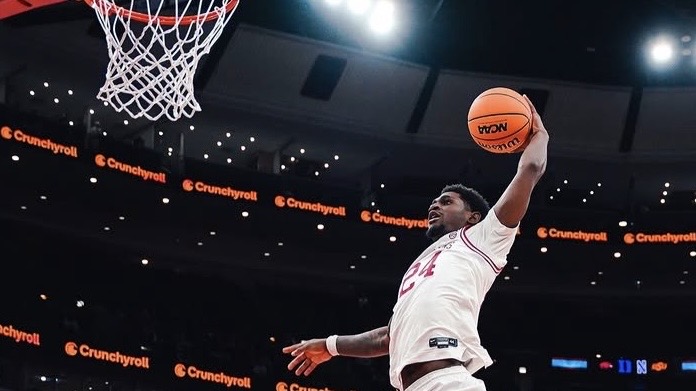
Billy Richmond III had every reason to test the NBA Draft process a little longer.
However, he will return to Arkansas for his junior season, according to Jon Rothstein.
He walked into the NBA Scouting Combine viewed as a second-round project, but left Chicago with enough intrigue to make teams rethink his value.
His motor, defensive versatility and athleticism in the open-floor all fit what NBA teams continue to search for in long, switchable wings.
But instead of forcing himself into a position in a loaded draft class, Richmond announced his return to Arkansas on Wednesday.
His decision gives coach John Calipari one of the most important pieces on next year’s roster as a proven, high-energy wing who fully understands the system, defends multiple positions and has shown enough offensive growth to believe another leap is coming.
Richmond has been known as the motor behind Calipari’s tempo scheme, offering exceptional defensive skill, full-court energy and constant activity in transition.
Those kind traits made him valuable the past two seasons that resulted in back-to-back appearances in the Sweet 16 of the NCAA Tournament.
The decision to return to Arkansas makes him arguably the most important veteran on a roster loaded with talented freshmen and transfers.
How Richmond Got Here
Richmond arrived at Arkansas after following Calipari from Kentucky as a member of the 2024 recruiting class. The former 5-star wing always carried value on both ends of the court, using his length, energy and instincts to make himself play bigger than his listed size.
His NBA Combine measurements only added to the hype.
Combine Measurements
Height: 6-foot-5.75
Weight: 195.4 pounds
Wingspan: 6-foot-8
Standing reach: 8-foot-5
Hand length: 9 inches
Hand width: 9.25 inches
Richmond lived off his defensive ability as a freshman, but it was his offensive breakthrough this season that made him a legitimate NBA Draft prospect.
Calipari took notice of Richmond’s expanded offensive skill set midway through the season, often encouraging him to shoot the three when open.
After hitting just 2 of 16 attempts from deep as a freshman, the Memphis native committed himself to becoming a more reliable shooter.
“Yeah, we went to him late because I trust [Richmond],” Calipari said after defeating Ole Miss in January. “I trust him defensively. I trust him to make his free throws. I trust him getting the ball in. One thing I got on the guys about, we have a machine in our gym called the NOAH, that charts all their shots. It’s face recognition. If you’re not going in there, I know, because I get all the numbers.
“I said, ‘Guys, I’ve got some of you that want to shoot balls in games that are not getting in the gym. You’re not staying after. You’re not coming early. You’re not coming back in the morning or late at night. If you really want to do this and make a living at this, it’s part of your routine.’”
That routine allowed Richmond to become a critical piece of the Razorbacks’ rotation after D.J. Wagner and Karter Knox suffered injuries midway through SEC play. While Richmond had already shown improved offensive efficiency, his expanded role allowed him to flourish with more playing time.
He started the final 15 games of the regular season, averaging 15 points, five rebounds, three assists, two steals and one block in 35 minutes per game.
His shooting splits reflected a more confident offensive player, as he made 57% of his attempts from the field, 28% from beyond the arc and 83% at the free-throw line.
Why Return Makes Sense
Richmond could have remained in the draft and bet on a team falling in love with his physical tools, defensive versatility and motor. That would not have been a reckless decision, and one Arkansas fans would’ve understood.
However, a return to Arkansas gives him a chance to become something more than a second-round developmental prospect at the wing.
With another season under Calipari, Richmond can potentially sharpen his three-point shot, improve as a half-court creator and prove his offensive growth is sustainable over a full season.
Should Richmond continue his surge in development, he could play himself into first-round territory by next summer. That’s actually already the case, but a gamble some prospects take returning for a third college season.
The NBA already knows Richmond can defend, guards with true grit, sits down in his stance, moves well laterally and makes sure whoever he guards is uncomfortable.
His length allows him to play a positionless style as someone capable of guarding the 1-4.
His energy shows up quickly on tape, contesting shots at every level, turns loose balls into transition opportunities and races to the rim whenever he has space in the open floor.
That kind of tenacity is what Calipari and the Razorbacks leaned on the past two seasons. Now, Arkansas gets it back at a time when the roster needs a key veteran to return.
What It Means for Arkansas
Richmond’s return gives Arkansas something every young roster needs: a veteran who can create for himself and others.
That matters for a vintage Calipari squad that features a freshman-heavy group of 5-stars such as Jordan Smith Jr., JJ Andrews, Abdou Toure, and Miikka Muurinen.
Arkansas is set to bring more elite talent from the transfer portal but Richmond gives the Razorbacks someone who already understands what Calipari requires from a physicality standpoint and the expectations that surround the program.
He is such a utility piece who can be instructed to defend an opponent’s best perimeter player, run the floor, rebound from the wing and give Calipari a tone-setter who plays with effort every possession.
The bigger question is whether Richmond can become a more consistent offensive threat.
If he makes another jump as a shooter, Arkansas’ postseason ceiling changes, but so does his NBA Draft stock.
He does not have to become the Razorbacks top scoring option, because Calipari has plenty of those kind of guys to go around. But what Richmond must be enough of a threat that defenses cannot ignore him in the half court.
Sometimes, draft decisions are about striking while the iron is hot, and Richmond had a real case to do that this offseason because it’s hard to replicate results year-to-year.
Instead, he is betting on himself in a different way.
By returning to Arkansas, Richmond gives himself a chance to move from intriguing NBA project to polished first-round prospect. For Calipari, he gives the Razorbacks a proven two-way wing who can anchor one of the most athletic rosters he’s ever assembled.